
New Delhi: India marked National Entrepreneurship Day on 9 November, the day the Ministry of Skill Development and Entrepreneurship was set up in 2014. The occasion highlights how entrepreneurship is driving the country’s journey towards Viksit Bharat 2047. Nearly 65 per cent of Indians are under 35, and the government says young people have moved beyond being beneficiaries to become active contributors to national development.
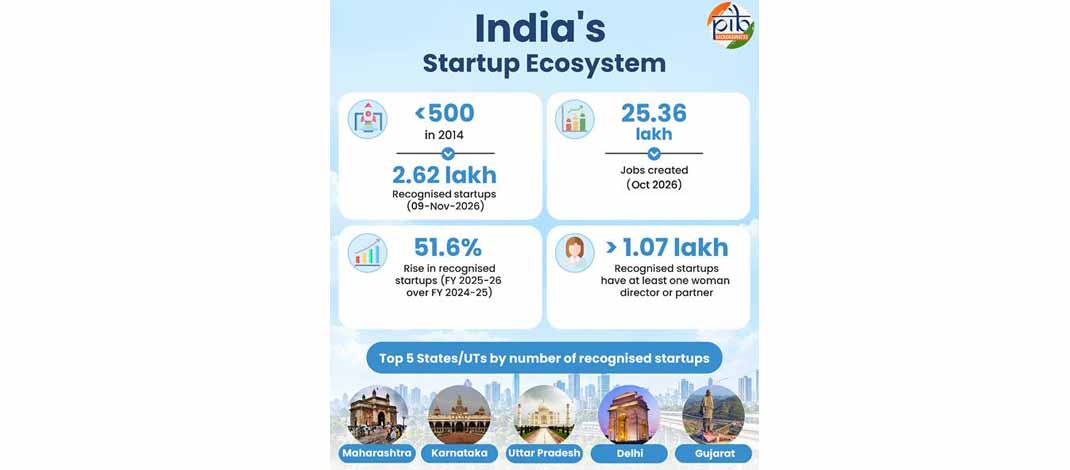
India now has the world’s third-largest startup ecosystem, with more than 2.62 lakh DPIIT-recognised startups as of November 2026, up from fewer than 500 in 2014. The government recognised over 55,200 startups in FY 2025-26, the highest in a single year since 2016, and recognitions rose 51.6 per cent over the previous year. Startups have created more than 25 lakh direct jobs up to October 2026, and direct jobs created in FY 2025-26 rose 36.1 per cent. Maharashtra, Karnataka, Uttar Pradesh, Delhi and Gujarat lead in recognised startups and direct employment. More than 1.07 lakh startups, about 48 per cent, have at least one woman director or partner, and 52 per cent come from non-metro cities.
Startup India, launched in 2016, anchors the government’s support. The ₹10,000 crore Fund of Funds for Startups, managed by SIDBI, has committed ₹12,623 crore to 166 alternative investment funds, which have invested ₹28,254 crore in 1,475 startups. A second Fund of Funds, also worth ₹10,000 crore and focused on deep-tech and manufacturing, was notified in April 2026. The Credit Guarantee Scheme for Startups has guaranteed 532 loans worth ₹1,662.71 crore, and its guarantee cover was raised from ₹10 crore to ₹20 crore per borrower. The ₹945 crore Seed Fund Scheme has approved ₹775.67 crore for 4,194 startups through 244 incubators. The MAARG mentorship portal and the Investor Connect Portal, where 11,582 startups are registered, also support founders.
Other programmes cover different parts of the ecosystem:
- Atal Innovation Mission: AIM 2.0 has an outlay of ₹2,750 crore up to March 2028.
- MeitY Startup Hub: It supports over 6,149 startups and 518 incubators.
- TIDE 2.0: It works through 51 incubators.
- GENESIS: It has a ₹490 crore outlay and aims to scale around 1,600 technology startups, mainly in Tier-II and Tier-III cities.
- NIDHI: It has supported over 12,000 startups and generated over 1.3 lakh jobs.
- ASPIRE: It has approved 109 livelihood business incubators.
For smaller enterprises, the Pradhan Mantri Mudra Yojana offers collateral-free loans of up to ₹20 lakh across four categories: Shishu, Kishor, Tarun and Tarun Plus. It has sanctioned over 2.44 crore loans worth more than ₹3.3 lakh crore in FY 2026-27 as of 30 October. The PMEGP gives a 15 to 35 per cent subsidy on project costs, depending on location and category. PM SVANidhi has reached over 80.7 lakh street vendors with more than ₹20,400 crore sanctioned. The Swavalambini scheme, launched in 2025, trains young women entrepreneurs through 21 weeks of mentorship.
The government is also pushing entrepreneurship beyond the metros. In August 2026 it launched the National Campaign on Entrepreneurship-II under DAY-NRLM, running till 21 November, to support rural women towards the goal of 6 crore Lakhpati Didis. The Start-up Village Entrepreneurship Programme had supported 4.32 lakh rural enterprises by June 2026, and about 86 per cent of its entrepreneurs belong to SC, ST, minority and OBC communities.
The government says India’s startup ecosystem is moving from rapid expansion towards sustainable growth and closer links with the wider economy, as the country heads for a projected $7.3 trillion economy by 2030.