
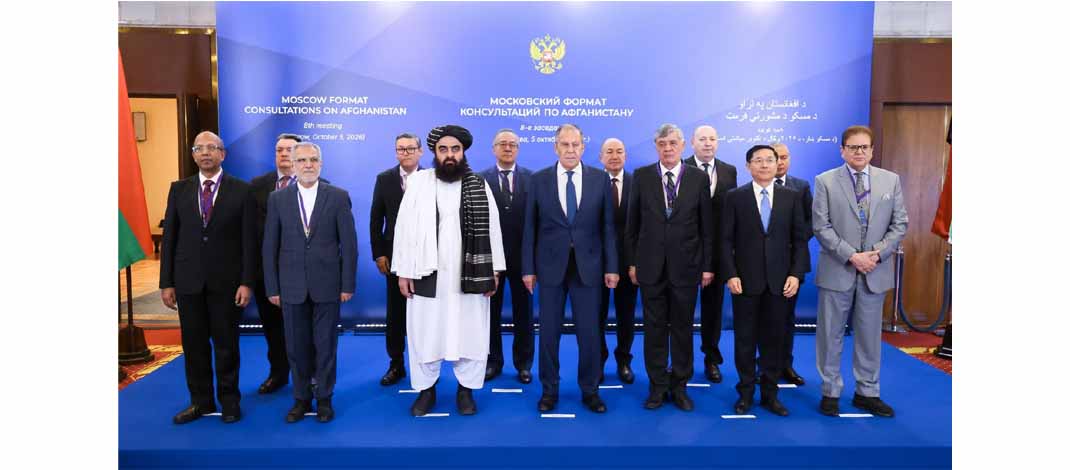
– India highlights its commitment to Afghanistan’s unity, territorial integrity and welfare as Russia hosts regional consultations involving key stakeholders
New Delhi/Moscow: India has reiterated its strong support for the sovereignty, unity and territorial integrity of Afghanistan, reaffirming its commitment to the welfare and well-being of the Afghan people at the 8th Moscow Format Consultations on Afghanistan, hosted by Russia in Moscow.
The Indian delegation at the consultations is being led by Ambassador to Russia Vinay Kumar and Joint Secretary (PAI) Dr M. Suresh Kumar. Representatives from participating countries are attending the consultations, with Afghanistan represented by Foreign Minister Amir Khan Muttaqi. Belarus and Egypt are participating as guest countries.
The Moscow Format provides an important regional platform for consultations on Afghanistan, bringing together countries with a direct stake in the country’s stability, security, connectivity and economic future. Discussions in such forums are aimed at encouraging a stable, peaceful and economically viable Afghanistan while addressing common regional concerns, including terrorism, extremism, narcotics and humanitarian challenges.
India-Afghanistan ties rooted in history and development partnership
India’s engagement with Afghanistan is based on historic, cultural and people-to-people ties and has traditionally focused strongly on development, capacity building, education, healthcare and humanitarian assistance. India’s approach since August 2021 has continued to be guided by its longstanding friendship with the Afghan people and relevant UN Security Council commitments. Ministry of External Affairs
India has provided substantial humanitarian assistance to Afghanistan in recent years, including 50,000 metric tonnes of wheat and 300 tonnes of medicines and medical/surgical supplies. India has also supported Afghan students through online scholarship programmes and continued capacity-building initiatives. Ministry of External Affairs
Connectivity remains another important dimension of India’s Afghanistan policy. Chabahar Port in Iran has provided an alternative connectivity route for India to Afghanistan and Central Asia, while India’s earlier development partnership included major infrastructure and community-development projects in Afghanistan. Ministry of External Affairs
Russia-India-Afghanistan regional engagement
Russia has traditionally been an important partner for India in discussions concerning Afghanistan and wider Central Asian security. The Moscow Format has emerged as one of the significant regional mechanisms for discussing Afghanistan’s political, security and humanitarian situation.
For India, participation in the Moscow Format also reflects its preference for regional and multilateral dialogue on Afghanistan, particularly on issues that have implications for regional stability and security.
India and Russia have also maintained longstanding strategic relations, including close political and diplomatic coordination on regional and international issues. Their engagement on Afghanistan forms part of this broader relationship, alongside cooperation in defence, energy, trade, connectivity and other strategic sectors.
Focus on stability, security and Afghan welfare
India has consistently emphasised that Afghanistan should not become a source of instability for the wider region and has stressed the importance of combating terrorism, extremism and drug trafficking, while ensuring humanitarian assistance reaches the Afghan population.
India’s participation in the latest Moscow Format consultations therefore underscores a three-fold approach — support for Afghanistan’s sovereignty and territorial integrity, continued humanitarian engagement with the Afghan people, and regional cooperation for peace and stability.
The consultations also provide an opportunity for participating countries to exchange views on Afghanistan’s evolving political and security environment and explore practical approaches to promoting regional connectivity, economic development and a peaceful future for the Afghan people. Ministry of External Affairs