
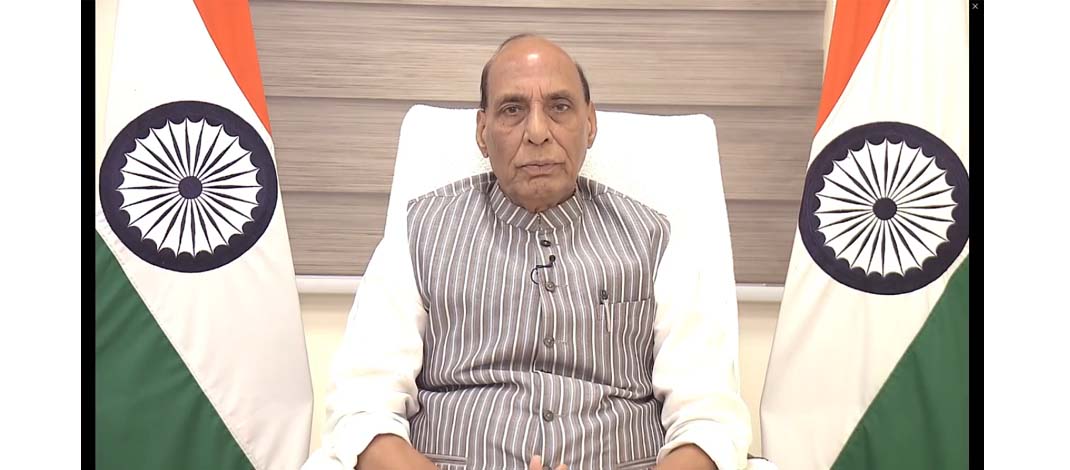
New Delhi : India’s defence capabilities have entered a new era of self-reliance, technological advancement, and global recognition, said Raksha Mantri Shri Rajnath Singh, highlighting the country’s remarkable transformation in the defence sector under the vision of Prime Minister Shri Narendra Modi-led Government.
Addressing an event in New Delhi on July 18, 2026, the Defence Minister described Operation Sindoor as a symbol of India’s modern defence preparedness and the success of sustained reforms guided by the principles of ‘Nation First’ and ‘Forces First’. He said the operation demonstrated the unmatched courage of the Indian Armed Forces and reflected the government’s firm policy of zero tolerance against terrorism.
Operation Sindoor: A Showcase of Indigenous Defence Strength
Shri Rajnath Singh said that India’s transformed defence ecosystem played a crucial role in the successful execution of Operation Sindoor, calling it an example of technology-driven warfare and confidence in Indian defence industries.
He highlighted the effective use of advanced systems including Akash Teer, Akash missile system, and BrahMos, along with other state-of-the-art defence technologies, as a result of the strong foundation built over the last 12 years.
Defence Production Touches Record High
Emphasising the progress of Aatmanirbhar Bharat in Defence, the Defence Minister informed that the government has issued five Positive Indigenisation Lists covering 509 defence items by the Armed Forces and five lists covering 5,012 items by Defence Public Sector Undertakings (DPSUs).
He announced that another Positive Indigenisation List will soon be introduced to further accelerate indigenous defence manufacturing.
Highlighting the achievements, Shri Rajnath Singh said India’s annual defence production reached a record ₹1.78 lakh crore in FY 2025-26, rising significantly from around ₹40,000 crore in 2014.
He added that defence exports have crossed an all-time high of ₹38,000 crore, compared to just ₹686 crore in FY 2013-14. India aims to surpass ₹2 lakh crore in defence production this year, achieve ₹3 lakh crore by 2029, and take defence exports to ₹50,000 crore by 2029.
India Builds a Strong Defence Industrial Ecosystem
The Defence Minister said that since 2014, the government has worked to change the traditional mindset of depending heavily on imports by promoting indigenous manufacturing of advanced weapons and technologies.
He stated that India has created a defence industrial ecosystem capable of meeting both domestic requirements and international demands.
According to Shri Rajnath Singh, defence self-reliance represents a major shift — from dependency to capability, from being a consumer to becoming a producer.
Defence Corridors and Innovation Ecosystem Boost Growth
Highlighting major reforms, the Defence Minister pointed to the Defence Industrial Corridors in Uttar Pradesh and Tamil Nadu as important steps towards strengthening manufacturing capabilities.
He said investments worth nearly ₹70,000 crore have been proposed in these corridors, with around ₹10,000 crore already invested, creating new employment opportunities and strengthening India’s defence supply chain.
He also highlighted the role of startups and MSMEs through initiatives such as iDEX, iDEX Prime, and ADITI, stating that more than ₹2,400 crore worth of procurement from startups and MSMEs has been approved, while projects exceeding ₹1,500 crore have been sanctioned for new technologies.
He informed that 676 startups and innovators are engaged through iDEX, with 551 contracts signed till March 2026, and the number of defence startups has grown from a few dozen in 2018 to over 2,000 today.
India Emerging as a Global Defence Partner
Shri Rajnath Singh said India is no longer only producing defence equipment for its own requirements but is emerging as a trusted global security partner, expanding its role from the Indian Ocean to the Indo-Pacific region.
He also highlighted the growing strategic importance of Prime Minister Narendra Modi’s visits to Indonesia, Australia, and New Zealand, which have strengthened India’s diplomatic, economic, defence, and cultural partnerships in the Indo-Pacific.
Vision for Viksit Bharat 2047
Concluding his address, Raksha Mantri said India’s defence transformation is driven by the collective efforts of scientists, soldiers, engineers, startups, MSMEs, industries, and the country’s youth.
He said the India of Amrit Kaal is not only securing its own future but also contributing towards global peace and stability. By 2047, India aims to emerge as a modern, reliable, and self-reliant defence power, he added.
“A strong and secure India, powered by indigenous technology and innovation, is the foundation of Viksit Bharat 2047,” Shri Rajnath Singh said.